What Is Decision Intelligence Software and Should You Invest in It?
New reports on decision intelligence software reveal how it helps businesses leverage AI and create more compelling customer experiences


For decades, FICO has empowered banks, financial services firms, telecommunications companies, insurers, and clients across many industries to automate and optimize their operational decisions at enterprise scale. This expertise has matured into a technology framework called FICO® Platform which has become the backbone of digital transformation for leading organizations around the world. FICO Platform facilitates the alignment and contribution of every department, application, employee, and partner in the enterprise to deliver tangible, measurable business results at a speed, scale and level of governance that manual or siloed approaches cannot match. Explaining such a comprehensive platform to clients and prospects can be complex but recent industry reports such as the 2026 Gartner® Magic Quadrant™ for Decision Intelligence Platforms, IDC MarketScape: Worldwide Decision Intelligence Platforms 2026 Vendor Assessment, and Forrester Wave™: AI Decisioning Platforms, Q2 2025 are bringing clarity to the conversation.
Key Takeaways
- Decision Intelligence Extends Beyond Business Intelligence. IDC observes that many vendors use the term for insight that stops short of acting on a decision or learning from its outcome. Gartner describes decision intelligence platforms as software that supports, augments, and automates decision making, with monitoring, governance, and learning from outcomes.
- Leading Analyst Firms Recognize FICO. FICO is named a Leader in the 2026 Gartner® Magic Quadrant™ for Decision Intelligence Platforms and positioned in the Leaders category of the IDC MarketScape: Worldwide Decision Intelligence Platforms 2026 Vendor Assessment. FICO is also the only vendor to have earned Leader status in every Forrester Wave™ AI Decisioning Platforms Wave report.
- Documented Deployments Demonstrate Measurable Impact. A top US credit card company achieved an ROI of 20:1 or higher in its first year. A global payments processor increased approval rates by nearly 60%. A global multinational bank reduced internal development costs by 80% and operational risk incidents by 70%.
- Adoption Is Already Underway. In Gartner’s 2024 CDAO Agenda Survey, 33% of respondents had deployed decision intelligence software, 17% were committed to doing so within six months, and 44% were considering it. Gartner projects that by 2028, 25% of CDAO vision statements will become “decision-centric.”
Since this post was first published in 2025, the conversation around the decision intelligence market has only grown stronger, and so has independent validation of FICO's leadership in this space. Most recently, FICO was named a Leader in the 2026 Gartner® Magic Quadrant™ for Decision Intelligence Platforms, recognized for Completeness of Vision and Ability to Execute. FICO is proud of this recognition that reflects its long commitment to enterprise-wide decisioning. FICO was also recognized in the 2026 Gartner® Critical Capabilities for Decision Intelligence Platforms across all four critical categories.
Between these reports and IDC's newly published IDC MarketScape: Worldwide Decision Intelligence Platforms 2026 Vendor Assessment, in which FICO is again positioned in the Leaders category, a clearer vision is emerging about what decision intelligence software is, how it can add tremendous value to businesses, and which companies are leveraging it to outpace their competitors.
How Do Gartner and IDC Define Decision Intelligence Software?
Gartner's Definition
In the 2026 Gartner® Magic Quadrant™ for Decision Intelligence Platforms, Gartner explains what decision intelligence and decision intelligence platforms are:
- Decision intelligence: "a practical discipline used to improve decision making by understanding and engineering how decisions are made and how outcomes are evaluated, managed, and improved by feedback." The Gartner report noted that in its 2024 CDAO Agenda Survey, 33% of respondents had already deployed decision intelligence software, 17% were committed to doing so within six months, and 44% were considering it. Just 7% were neither deploying nor considering it.
- Decision intelligence platforms (DIPs): "software to create decision-centric solutions that support, augment and automate decision making of humans or machines, powered by the composition of data, analytics, knowledge and AI. DIPs enable enterprises to collaboratively design and explicitly model decisions, orchestrate decision flow during execution at scale, and enable monitoring and governance of decision quality, while learning from actions and outcomes."
IDC's Definition
In the IDC MarketScape: Worldwide Decision Intelligence Platforms 2026 Vendor Assessment, IDC defines decision intelligence and the decision intelligence platform market as follows:
- Decision intelligence: "a discipline and set of technologies that help organizations design, engineer, and orchestrate decisions by fully or partially automating all steps in the decision-making process."
- Decision intelligence platforms: "the software technology that helps organizations design, engineer, and orchestrate decisions by fully or partially automating all the steps in the decision-making process", made up of three components:
- Decision design: "Decision design provides functionality for users to define business goals or desired outcomes; map decision-making workflows, including feedback loops and approval points; and identify choices and constraints that limit the available options of a decision-maker."
- Decision engineering: "Decision engineering provides functionality to organize the available data using semantic and/or ontological frameworks and analyze the data using a range of use case–specific methods that may include simulation, optimization, descriptive, and predictive analysis. The output of this process is a prioritized list of impact-weighted options or a recommendation presented to a decision-maker, or a fully automated decision made by the system."
- Decision orchestration: "Decision orchestration provides functionality to monitor all elements of the decision-making workflow (e.g., rules, algorithms, data sets, approval hierarchies, goals, constraints, decisions) and enable their ongoing or periodic adjustment based on automated and human-generated feedback loops. Orchestration also enables ongoing learning about decision-making processes and outcomes of decisions by providing functionality to catalog and analyze these decision intelligence artifacts. This will also include decision governance."
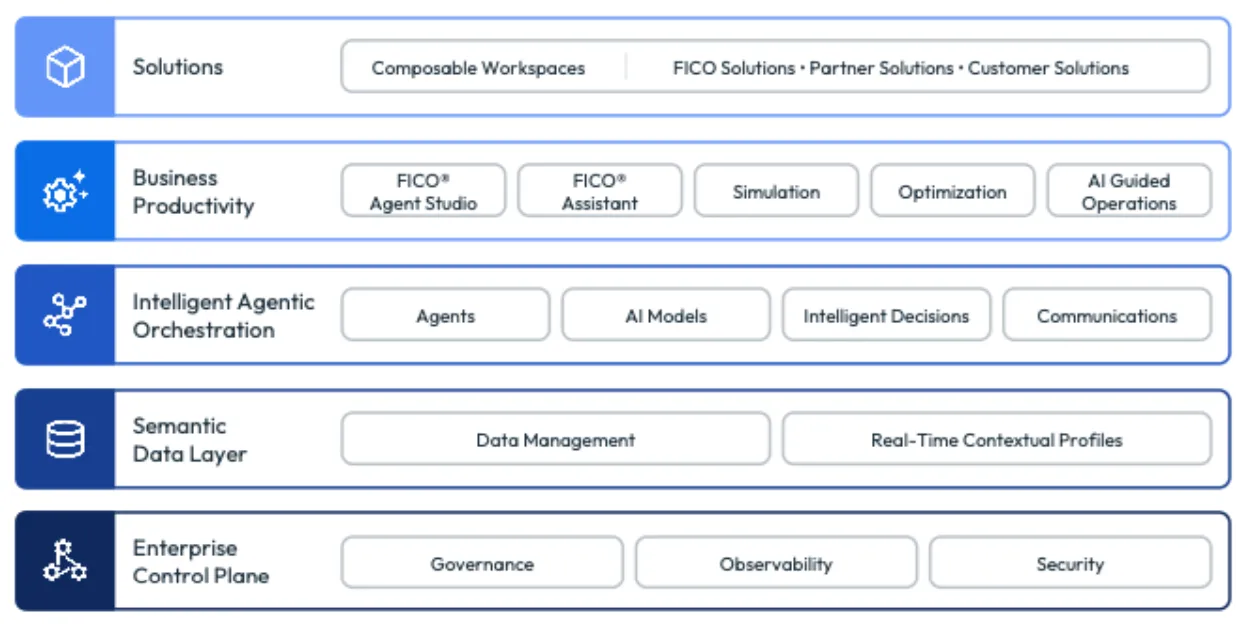
These definitions correspond with the capabilities in FICO® Platform:
Two terms that people frequently confuse with decision intelligence software are:
- Business intelligence software. BI software focuses on gathering, organizing, and summarizing data in ways that help managers make management-level decisions. These tend to be more manual and less frequent. BI is not designed to automate operational-level decisions for the business. .
- Decision support systems. As implied by the word ‘support’, DSS are also not designed to make decisions on behalf of the business. They are like BI in certain respects, but are more focused on a vertical domain such as fleet management, insurance fraud, or institutional investing to name a few. Within its scope of specialization, a DSS is designed to help human experts determine the right course of action, which is why a knowledge base is often considered an important feature of a DSS and where GenAI is well-suited to play an increasingly important role.
How Decision Intelligence Platforms Work
A decision intelligence platform unifies data, business rules, machine learning, and optimization into a single continuously operating system. It models a decision, executes it, and feeds outcomes back to sharpen every subsequent cycle. As defined by the analysts, this closed loop is what fundamentally separates decision intelligence software from static software, as precision compounds with each iteration.
1. Decision Modeling: Start With the Decision, Not the Data
The decision comes first: the desired outcome, the applicable constraints, the required data inputs, and the points where human judgment must remain. FICO calls this approach "working backwards from the decision."
2. Data Ingestion and Feature Engineering
Data is ingested from internal and external sources and transformed into a governed, business-friendly feature library shareable across the enterprise. This is what eliminates the data silos responsible for fragmented, context-deficient decisions.
3. Analytics and AI Model Execution
Machine learning, statistical models, and increasingly agentic AI produce the risk scores and predictions behind each decision. Explainable AI attaches an auditable, human-readable reason code to every output.
4. Decision Automation and Strategy Execution
Analytical outputs are integrated into governed strategies using rulesets, decision trees, decision tables, and decision models. Business users define risk appetite and policy directly, with full auditability.
5. Exception Management and Human Oversight
Cases with elevated risk or complexity are automatically routed to a qualified human reviewer. Routine decisions continue executing autonomously, with oversight built into the architecture rather than added as an afterthought.
6. Omnichannel Communication and Action
The decision reaches the customer through the right channel at the right moment: a credit offer, a fraud alert, a collections outreach, or a next best action recommendation.
7. Simulation and Strategy Validation
New strategies are evaluated against actual historical data before deployment, enabling teams to assess likely outcomes and refine logic without exposing live customers or business results to risk.
8. Decision Optimization
Mathematical optimization identifies the strategy that best satisfies stated business objectives, such as maximizing approvals, minimizing loss, or reducing fraud cost, within defined operational and regulatory constraints.
9. Monitoring, Reporting, and the Feedback Loop
Outcomes are monitored continuously, and performance signals feed back into the system to detect model drift and improve subsequent decisions. Managing this loop with discipline through structured benchmarking and iteration is the practice known as DecisionOps.
The Result
This closed loop is what separates decision intelligence software from static software, with governance and explainability embedded throughout the architecture rather than applied as a downstream compliance exercise.
What Are the 5 Key Benefits of Decision Intelligence Software Platforms?
Gartner's 2026 Magic Quadrant for Decision Intelligence Platforms highlight five critical benefits of decision intelligence platforms that are important for organizations investing in this software.
1 Manage increasing business complexity through decision-centric modeling
Decision intelligence helps organizations manage the growing complexity of business decision-making. As global competition intensifies, disruptions become more frequent, and customer expectations rise, decision intelligence software gives organizations a way to keep decisions accurate and connected. It also helps them keep pace with digital business and meet growing regulatory pressure around fairness and transparency.
Gartner states that “By 2028, 25% of CDAO vision statements will become 'decision-centric,' surpassing 'data-driven' slogans, with human decision-making behaviors explicitly addressed to improve D&A value.” FICO shares this perspective; as clients proceed on their digital transformation journey, we encourage them to “work backwards from the decision.” This helps them identify all of the inputs and decision assets that must be continually updated, verified, and synchronized to ensure optimal decisions even amid rapidly evolving market conditions. This is embedded in FICO’s decision modelling approach.
2 Balance scalability and transparency with personalized decisions
Gartner reports that the overall demand for decision intelligence platforms is expected to grow, driven by pressure on organizations to make decisions that are more scalable and transparent, yet more contextualized and personalized. This must be achieved in a business environment that is being continually disrupted by global competition and emancipated consumers and citizens.
These Gartner findings certainly mirror our experience at FICO: the number of companies using FICO Platform for enterprise decisioning has grown from a dozen to 130+ in the past 48 months or so; clients are quickly achieving dramatic results in their digital agendas, customer acquisitions, and efficiency ratios.
3 Break through technology and information silos with a unified decision platform
To improve decision quality, fragmented, non-contextualized, data-deficient choices should not be the ones we are automating and scaling. Furthermore, fixing this is not possible on splintered business unit-level systems, department-level data science predictions or a variety of other, silo-induced blind spots.
At FICO, we help clients implement a unified, scalable decision platform across the enterprise to optimize and monetize decision-making. By unifying and leveraging all available information and applying a collection of different techniques and algorithms, a platform connects the dots and fills in the holes in decisioning processes to ensure better decisions at every customer touchpoint across the lifecycle, to iteratively improve the quality of decisions over time. This also ensures a cohesive, all-inclusive customer experience that promotes customer engagement.
4 Compete using AI and machine learning integrated into decision-making
The growing power of AI offers game-changing opportunities to bring decision-making to a higher level of strategic competitive differentiation. However, most organizations find it challenging to turn the promise of AI into reality, often due to a disconnect between technological possibilities and operational decision-making at the point-of-contact with the customer. By empowering business users to take more control of their AI-powered decisions, they can make better trade-offs and choose better actions. By reducing their dependence on IT, a platform unclogs bottlenecks and enables everyone to move faster. It effectively combines the “book smarts” of the IT organization with the “street smarts” of the business to accelerate learning cycles across a wider range of scenarios to swiftly respond to shifts in business conditions while remaining timely, personalized, and highly relevant in every customer moment.
5. Empower business users to improve decisions
Decisioning platforms are seen as critical in dealing with 21st century challenges of existing enterprise decision-making as well as in enabling novel ways to differentiate.
Gartner further mentions the need for what it calls decision collaboration: "The capability to improve human-AI delegation, minimizing friction between human and machine decision actors within teams, enterprises and ecosystems. It generates decision workflows, ethics and outcomes safeguards, guardrails and alerting thresholds for input/output monitoring and risk mitigation." Again, we think FICO’s vision of not just a human-led, but a business user-led enterprise decisioning strategy ensures all of the benefits of a symbiotic people/process/ technology approach to decisioning and digital maturity.
We think this report reinforces what we at FICO have been advocating for years, the need for a holistic approach to making decisions, powered by innovations in data management, AI, analytics and more.
How Is Decisioning Intelligence Used Across the Enterprise and Industries?
Decisioning Intelligence in the Enterprise
Enterprise Fraud Management Decisioning platforms strengthen enterprise fraud management by minimizing the cost and negative customer experience of multichannel fraud patterns like account takeover (ATO). Rather than relying on siloed, single-channel fraud rules, a unified decisioning platform correlates signals across every customer touchpoint to catch fraud patterns earlier and with fewer false positives.
A major Latin American bank applying FICO Platform reduced gross fraud by 20% while reducing the time required to confirm transactions by 90%. A global payments processor using a single underwriting and decision management platform increased accuracy to reduce portfolio risk, cut costs, and minimize fraud, while scaling across multiple verticals, product lines, and regions.
Lending and Origination
Decision management expands lending by improving pricing and risk assessment, using previously siloed data across divisions to make faster, more accurate underwriting decisions. This directly addresses the technology and information silos discussed earlier in this guide: when pricing, risk, and customer data live in separate systems, lenders cannot see the complete picture needed to price risk accurately or extend credit responsibly.
The global payments processor case study demonstrates this at scale. By building a single underwriting and decision management platform, the company increased approval rates by nearly 60% and cut induction time from several days to a few minutes. It also rolled out tiered underwriting, underwriting-as-a-service, and a consumer underwriting application.
Collections and Recovery
Decision automation reduces losses through next-generation collections and recovery capabilities, replacing static, one-size-fits-all recovery strategies with adaptive, data-driven approaches that adjust to each customer's specific situation and likelihood of repayment. This is decision automation applied to a stage of the customer lifecycle that has traditionally relied on manual case-by-case judgment, making it slower and less consistent than an automated, governed decisioning approach.
Customer Lifecycle Management
Decision management improves the customer experience by delivering effective, targeted omnichannel communications and AI-informed customer relationship management (CRM), including next best action recommendations at every touchpoint.
A large APAC bank applying this capability achieved instant, customer-centric digital decision management. New capabilities enabled the bank to quickly expand into new customer segments while increasing the profitability of existing relationships. Business users could generate new dashboards and reports without IT involvement. The bank also launched a new digital business starting with its personal loan portfolio, and quickly met or exceeded the offerings of competing fintechs.
The functions above are proven most deeply in banking. The same platform capabilities extend to other regulated, high-volume industries.
Insurance
Insurance carriers use decisioning intelligence to automate claims decisions, detect fraudulent claims, and support underwriting. The same rules, machine learning, and governance capabilities used in banking apply directly to insurance-specific risk decisions, where accuracy and auditability carry similar regulatory weight.
Telecommunications
Telecommunications providers apply decisioning intelligence to detect subscriber fraud and manage churn risk in real time. The same real-time decisioning capabilities built for financial services extend naturally to the high transaction volumes telecom providers process daily.
Healthcare
Decision intelligence platforms also serve healthcare, though this vertical is less mature than banking, insurance, and telecommunications. Platforms in this category support claims processing and compliance-driven decisions. Gartner's 2026 Magic Quadrant confirms healthcare as an active vertical within the broader decision intelligence platform market.
Manufacturing
Decision intelligence platforms also serve manufacturing, supporting supply chain and operational resource decisions. Gartner's 2026 Magic Quadrant confirms manufacturing as an active vertical within the broader decision intelligence platform market.
How Does Decision Intelligence Use AI?
AI is not an add-on to decision intelligence. Gartner defines decision intelligence platforms as software "powered by the composition of data, analytics, knowledge and AI," making AI one of four core building blocks used to design, automate, and govern decisions, not a separate initiative layered on top.
AI for Prediction and Scoring
Inside the decision loop, machine learning models can generate predictions behind each decision. These models can be built natively in the platform or imported from external data science environments, then applied directly inside governed decision strategies rather than left as standalone outputs.
Agentic AI for Monitoring and Authoring
IDC describes agentic AI as an extension of generative AI inside the decision loop. GenAI accelerates decision design, letting business users build, test, or modify rules and models through natural language rather than code. Agentic AI extends this by enabling autonomous or semiautonomous agents to monitor decisions in production, recommend adjustments, and in some cases initiate changes to the decisioning flow itself.
IDC reports that the majority of vendors highlighted that agentic AI will largely be used for authoring, updating, or explaining decision logic in natural language rather than for making the decision itself. All of this continues to be carried out under human oversight.
Explainable AI for Auditability
IDC notes that multiple vendors "stressed that decisions must be traceable back to the data, rule, or model version that produced them, citing regulatory pressure as the reason." In its advice for technology buyers, IDC states: "It is important to examine the depth of the decision audit trail, traceability, and human-in-the-loop governance capabilities." In its FICO profile, IDC states: "Every decision carries embedded explainability, data lineage, and audit traceability."
Together, these three layers let decision intelligence platforms scale AI into millions of live decisions while keeping every decision explainable and governed.
What Are IDC's Key Findings on Decision Intelligence Platforms in 2026?
IDC's study assesses vendors in the worldwide decision intelligence platform market. This research, conducted in the first half of 2026, is based on the IDC MarketScape methodology. Key findings include the following:
- “Vendors within this market frame their platform as pairing rules-based, deterministic decisioning with machine learning (ML) and generative AI, rather than replacing one with the other. Many vendors highlighted that regulated use cases keep the final decision deterministic, even as GenAI or agentic AI support the overall process.
- Most of the vendors highlighted that agentic AI capabilities will largely be used for authoring, updating, or explaining decision logic in natural language rather than for making the decision itself.
- Multiple vendors noted that governance features are expanding beyond IT/technical audiences to serve auditors, boards, and compliance teams directly. They also stressed that decisions must be traceable back to the data, rule, or model version that produced them, citing regulatory pressure as the reason.
- All vendors offer a drag-and-drop or visual canvas for building decision logic, flows, or graphs, generally with an underlying code layer for more technical users.
- Decision intelligence platforms now include live dashboards tracking volumes, latency, model/rule performance, and drift, often with the AI assistant able to summarize or query this data conversationally.
- Platforms continue to expand their integration with external data providers, cloud data platforms, and business systems (CRM, core banking, etc.) as inputs to the decisioning process.”
Case Study: How the Bradesco "Brain" Delivers Hyper-Personalized Banking
An excellent example of this kind of software at work is Bradesco, the second largest bank in Brazil, which has created a system known as the Bradesco Brain, powered by FICO® Platform. Bradesco uses this system to create hyper-personalized customer journeys, based on analysis of data from across the bank, predictions of customer needs and responses, and automated decision-making. Bradesco’s hyper-personalized credit strategy has seen excellent results: including 30+ million visits per month to Bradesco’s loan menu, with more than half of users applying for a loan, a conversion rate of over 30% and very high customer reviews.
In a FICO® World 2024 presentation, Marcelo Perego, Product Manager at Bradesco, shared three real-life examples of Bradesco Brain in action:
- Marie’s Loan for a Birthday Party, Marie needed a loan of 8,000 reais (about $1,500) to organize her daughter’s birthday party. When she accessed her credit menu on the Bradesco site, she was asked, “How much do you need?” Marie entered the amount, and “in real time, our FICO Platform identifies solutions for her, taking into account her credit rating and needs,” said Perego. This personalized credit offer resulted in an immediate, customized solution.
- Juan’s Refinancing Opportunity. Juan, who had lost his job, faced challenges with two low-balance contracts, including one installment five days overdue. “Bradesco’s decision engine identified this behavior and recommended refinancing for him,” Perego explained. “Juan could extend the term with a lower installment, and the best solution was presented in his credit menu.” This approach reduced risk for Bradesco and supported Juan’s financial needs.
- Rodrigo’s Seamless Digital Experience. Rodrigo preferred speaking directly with his account manager but couldn’t visit the bank. His manager applied for a loan, making the contract available for review and acceptance via the Bradesco app. “Rodrigo saw the offer, checked the conditions, accepted the contract, and the amount was immediately released into his account,” Perego noted, showing how Bradesco’s omnichannel strategy delivers convenience and enhances customer satisfaction.
Gartner deserves kudos for explaining decision intelligence and decision intelligence platforms in such deep detail and great clarity. I would encourage anyone in the midst of a digital transformation effort or exploring an enterprise decisioning solution for their company to get a copy. The IDC MarketScape report is also extremely informative.
Speaking of third-party analyst validation, Forrester also published an excellent review of offerings in this space, called The Forrester Wave™: AI Decisioning Platforms, Q2 2025. FICO is the only vendor to earn “Leader” status in every Forrester AI Decisioning Platforms Wave since they’ve been published.
Among other things, these analyst firms agree: the choice to invest in decision intelligence software is a wise one and the time is now.
What Did IDC Say About FICO in the 2026 MarketScape?
FICO is positioned in the Leaders category in the 2026 IDC MarketScape for worldwide decision intelligence platforms. IDC's profile lists the following strengths:
- “Stateful, real-time profiling: FICO Platform builds always-on customer profiles that synthesize interactions continuously rather than treating each decision as a discrete, stateless event, supporting use cases such as high-volume payments fraud detection processed with sub-millisecond latency.
- Expanding ecosystem and marketplace: A growing marketplace for third-party data and model providers, long-standing relationships with payment processors, and recently formalized alliances with global systems integrators are intended to broaden distribution and accelerate implementation.
- Agentic policy authoring: Business users can upload strategy documents and layer in institutional expertise, after which the system generates decision assets with traceability back to the originating document section, along with testing and simulation tools to validate outcomes before deployment.”
IDC recommends FICO for large, heavily regulated environments, particularly financial institutions and telecommunications providers that need:
- Real-time, auditable decisioning
- A solution that can be used across fraud, credit, and customer engagement
- Models built and consolidated across multiple languages and tools into a single execution layer.
Learn How FICO® Platform Can Power Your Digital Transformation and Boost Collaboration
- With 33% of senior data and analytics leaders already deploying decision intelligence software and 44% considering it, independent analyst research provides the clearest framework for evaluating vendors and capabilities. Download the complimentary 2026 Gartner Magic Quadrant for Decision Intelligence Platforms to review how leading vendors are assessed for Completeness of Vision and Ability to Execute, and determine which decision intelligence platform is best aligned with your organization's requirements.
- Understanding the capability differences is the first step, and selecting the right platform for your specific organizational use case is the next. The 2026 Gartner Critical Capabilities for Decision Intelligence Platforms provides a granular, use-case-by-use-case comparison across Decision Analysis, Decision Engineering, Decision Science, and Decision Stewardship. Download the complimentary report to identify which platform capabilities are most aligned with your highest-priority decisioning requirements.
- Forrester named FICO a Leader in its AI Decisioning Platforms Wave Report, stating directly that "FICO lives, thinks, and breathes decisions," and recognizing it for superior governance capabilities and excellence in decision authoring, testing, and optimization. FICO is the only vendor to have earned Leader status in every Wave Report since the category was established. Download The Forrester Wave: AI Decisioning Platforms, Q2 2025 Report to see how every leading vendor is independently scored and determine which platform best fits your organization.
- Enterprise results, including a 20:1 ROI on automated decisioning, 60% higher loan approval rates, and 70% fewer operational risk incidents, show the measurable impact of decision intelligence software at scale. The IDC MarketScape: Worldwide Decision Intelligence Platforms 2026 Vendor Assessment positions FICO as a Leader, offering an independent view of how vendors compare globally. Download the complimentary report to benchmark your platform choice against IDC's criteria.
Disclaimer: Gartner does not endorse any vendor, product or service depicted in its research publications, and does not advise technology users to select only those vendors with the highest ratings or other designation. Gartner research publications consist of the opinions of Gartner’s research organization and should not be construed as statements of fact. Gartner disclaims all warranties, expressed or implied, with respect to this research, including any warranties of merchantability or fitness for a particular purpose
Gartner and Magic Quadrant are trademarks of Gartner, Inc. and/or its affiliates.
This is an update of a post from 2025.
Frequently Asked Questions
Explainable AI refers to the capability of an AI system to provide clear, auditable, and human-readable reasons for every decision it produces. In a regulated enterprise environment, this is not optional: financial regulators require institutions to be able to explain credit, fraud and risk decisions to customers and examiners. A decisioning platform with native explainable AI produces decision audit logs and reason codes that satisfy adverse action notice requirements, fair lending examinations and model risk governance frameworks. It also allows business users and compliance teams to inspect and challenge decision logic without requiring data science expertise, reducing the gap between model development and regulatory accountability.
ROI from a decision management platform is typically measured across four dimensions: revenue impact from improved decision accuracy, cost reduction from automation and reduced IT dependency, risk reduction from lower fraud and credit losses, and speed improvement measured as time to market for new strategies. Organizations entering an evaluation should establish baseline metrics across these four dimensions prior to deployment to enable consistent pre- and post-deployment comparison. In documented deployments on FICO Platform, a top US credit card company achieved a 20:1 ROI on automated decision management in its first year, a global multinational bank reduced internal development costs by 80% and time to market by 50%, and a large EMEA bank transformed a projected loss into a $6.5 million profit in under six months.
Responsible AI governance within a decisioning platform operates across three layers: decision transparency, which requires every automated decision to carry an auditable record of the data, models, and rules that produced it; bias and fairness monitoring, which requires continuous evaluation of decision outcomes across protected customer segments to detect and correct disparate impact; and human oversight controls, which route edge cases and high-stakes decisions to experienced human reviewers rather than relying on full automation. The Forrester Wave evaluation defines these as mandatory platform capabilities, specifically identifying "audit trails, explainability, and compliance controls" as the baseline requirements for enterprise-grade AI decisioning governance. Organizations that embed governance at the platform level rather than applying it as a downstream audit function are better positioned to respond to regulatory examinations and to sustain public trust in automated decisioning at scale.
A production-grade decisioning platform is designed to operate as an orchestration layer rather than a replacement for existing systems, consuming data from legacy core banking platforms, CRM systems, data warehouses, and third-party data providers through standard APIs and data ingestion connectors. The platform does not require organizations to decommission existing infrastructure before realizing value. The integration approach prioritizes incremental deployment, allowing organizations to connect one decisioning domain at a time and build toward an enterprise-wide unified platform.

Popular Posts

Average U.S. FICO® Score at 716, Indicating Improvement in Consumer Credit Behaviors Despite Pandemic
The FICO Score is a broad-based, independent standard measure of credit risk
Read more
The GSE Data Is Public. Here's What It Shows About Credit Score Modernization.
Independent Milliman analysis of GSE historical data confirms what anyone can now verify directly: FICO® Score 10T is the most predictive score.
Read more
FICO® Score High Achievers: Is Age the Only Factor?
We've refreshed our study on the credit behavioural profiles of consumers with higher FICO Scores, with a strong focus on younger consumers.
Read moreTake the next step
Connect with FICO for answers to all your product and solution questions. Interested in becoming a business partner? Contact us to learn more. We look forward to hearing from you.